


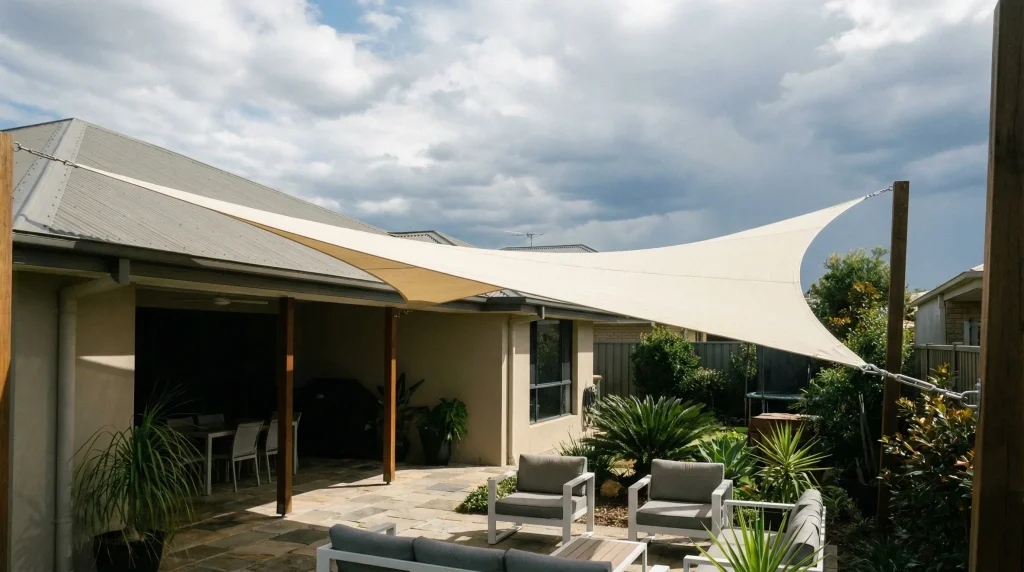
Coastal wind does more damage to outdoor shade than sun ever will. A sail that looks fine in a light breeze can tear free in a storm, taking posts, fittings and sometimes roof fascia with it. In northern Australia, a single cyclone can flatten an undersized frame.
A shade structure built for these conditions starts with wind data, not looks. Your site’s wind region, terrain and exposure decide the size of every post, footing and fitting.
This guide covers wind ratings, engineering, materials, fabric and storm preparation. Use it to plan a shade structure that holds up on exposed coastlines from Geraldton to Cairns.
Know Your Wind Region
The Australian wind standard, AS/NZS 1170.2, divides the country into wind regions.
- Region A: most of southern and inland Australia
- Region B: an intermediate zone along parts of the Queensland coast and the northern edge of the country
- Region C: cyclonic coasts, including Cairns, Townsville, Mackay and Darwin
- Region D: the most severe zone, covering the Pilbara coast in WA
Region is only the starting point. Engineers also assess terrain category, shielding from nearby buildings and topography. A house on a headland or open dune faces far higher loads than one in a sheltered suburb.
Engineer the Shade Structure for Wind Load
Get engineering certification for any structure in Regions B, C or D, and for large sails anywhere on the coast. The engineer calculates wind pressure on the fabric, then sizes posts, footings and fixings to match.
Many cyclonic designs assume the fabric comes down before a cyclone arrives. Ask your engineer which wind speed the design assumes, and confirm what your council accepts.
Specify Posts and Footings Properly
- Use heavier steel sections. Wider, thicker posts resist bending under sustained gusts.
- Rake posts outward. Angling posts away from the sail helps them resist fabric tension.
- Go deep with footings. Sandy coastal soils need larger, deeper bored piers than firm clay.
- Avoid weak fixings. Never tension a sail off fascia or gutters without engineered brackets.
Choose Materials That Resist Corrosion
Salt air attacks metal quickly, especially within a kilometre or so of breaking surf.
- Frames: hot-dip galvanised steel, ideally with a marine-grade powder coat over the top
- Fittings: 316 marine-grade stainless steel turnbuckles, shackles and pad eyes
- Cables: 316 stainless wire rope, sized to the engineered loads
Rinse fittings with fresh water every few months to remove salt build-up.
Pick the Right Fabric
Breathable HDPE shade cloth lets wind pass partly through the weave. That lowers the load on the frame and suits most exposed sites. Waterproof PVC catches the full force of the wind, so it needs a much stronger structure.
Shape matters too. A hypar design, with corners at alternating heights, creates a stiffer surface that flaps less in gusty conditions.
Prepare for Storms
- Fit quick-release fittings so you can drop sails in minutes.
- Label each corner to make reinstallation simple.
- Watch Bureau of Meteorology warnings and remove sails at the cyclone watch stage.
- Store fabric clean and dry to prevent mould.
- Inspect posts and fittings after every major storm.
Confirm your wind region and site exposure first. Engineer posts, footings and fittings to suit, and use galvanised steel with 316 stainless hardware. Choose breathable fabric where possible, and plan for fast removal before severe weather. Start by checking your wind region with council, then brief an engineer before you buy materials.